Hello, my name is Michael, an independent data analyst from Nieuwmount. Over the past few years, I’ve worked with researchers across different fields, helping them use AI tools in their academic work. Today, I want to share some practical tips on choosing the right AI tool for your research needs.
I’ve noticed that many of my colleagues dismiss AI tools completely. Some see them as threats to academic integrity, while others simply don’t trust technology in scholarly work. I understand these concerns: they come from our commitment to quality and truth. However, I believe that if we use AI responsibly, there’s no problem with academic integrity. After all, academic misconduct existed long before AI. Plagiarism, fake data, and questionable practices have been around for generations.
The Pre-Made Meal Analogy
Let me share a perspective from Chinese food culture that I find interesting. Traditional Chinese cooking emphasizes freshness and flavor above all else. The wok-based cooking method requires experienced chefs, high-temperature oil, and lightning-fast stir-frying techniques. This craft takes years to master—the perfect balance of heat, timing, and ingredient preparation creates dishes that capture the essence of “wok hei,” that irreplaceable smoky flavor.
However, modern society has changed everything. People no longer have time to prepare lunch and dinner from scratch. Labor costs keep rising, making traditional cooking methods economically challenging. Even more significantly, busy shopping malls and city centers now ban open-flame cooking for safety reasons. These pressures have led to the birth of pre-made meals—industrially produced food that only needs simple heating before serving.
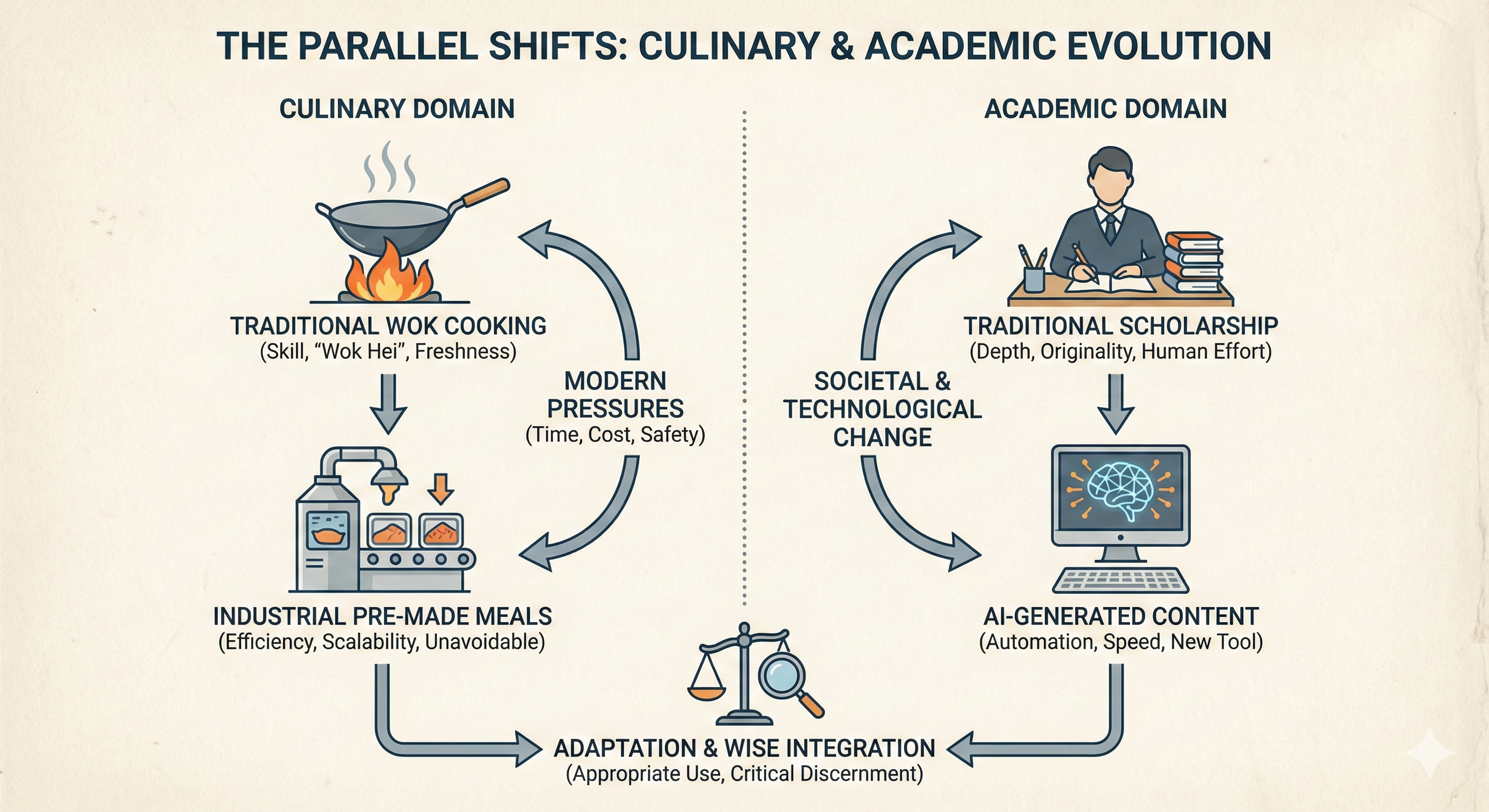
Many people resist this change. They’d rather eat at questionable street stalls than accept pre-made meals, viewing them as inferior to “real” cooking. Yet just as modern society has made pre-made meals unavoidable, AI-generated content has become unavoidable in our work. The academic community is no exception. Rather than fighting this change, I encourage us to learn how to use it wisely, knowing what’s appropriate and what’s not.
Three Key Uses of AI in Academic Research
Through my work, I’ve found three areas where AI tools provide immediate, practical value:
1. Data Analysis
AI tools have changed how we approach data analysis. They’re not just code generators—they act as math consultants that can check principles, suggest analytical approaches, and find potential errors.
AI tools are great at: - Generating and fixing statistical code in R, Python, or other languages - Explaining complex statistical ideas in simple terms - Checking math assumptions and finding potential problems - Suggesting good visualization methods
2. Academic Writing: Helping Non-Native Speakers
For researchers whose first language isn’t English—and I work with many brilliant scholars—AI tools can be powerful writing assistants. They don’t write papers for you. Instead, they help make your ideas clearer and more professional.
Beyond grammar fixes, these tools help with: - Improving sentence flow and connections between paragraphs - Suggesting better academic words - Finding unclear statements - Adjusting tone for different journals
3. Resume and CV Development
Academic CVs need smart presentation of research achievements, publications, and teaching experience. I’ve helped many early-career researchers turn generic descriptions into strong stories of their scholarly impact.
AI helps with: - Adding specific numbers to achievements - Tailoring CVs for different jobs - Finding gaps in your presentation - Suggesting strong action words
Comparing Major AI Tools: Which One Should You Choose?
Based on my testing and client feedback, here’s how the major AI tools compare:
| Tool | Data Analysis | Academic Writing | CV Development | Best For |
|---|---|---|---|---|
| ChatGPT | Excellent for step-by-step explanations and detailed code | Works well across all fields; adapts to different styles | Strong at creating variations for different contexts | Overall versatility and detailed help |
| Claude | Great at complex statistical thinking and explaining choices | Keeps your authentic voice while improving clarity | Thoughtful about showing real achievements honestly | Complex reasoning and keeping scholarly voice |
| Gemini | Good connection with Google Colab; strong visualization tips | Effective for quick edits; can use uploaded papers as examples | Useful for formatting and comparing to job descriptions | Google tools integration and quick work |
| DeepSeek | Strong math reasoning at lower cost; clear technical answers | Efficient for straightforward editing in STEM fields | Cost-effective for multiple drafts | Budget-friendly and technical content |
My Recommendations
Important Note on Pricing: The most powerful versions of all these AI tools require paid subscriptions, typically around €20 per month. This gives you access to the latest models with better reasoning capabilities and fewer usage limits. However, if you prefer not to pay subscription fees, both ChatGPT and Gemini offer free versions that are adequate for basic tasks. While these free versions have limitations—such as access to older models, slower response times, and usage caps—they can still handle routine academic tasks reasonably well. For occasional users or those just exploring AI tools, the free versions are a good starting point.
If you have decided to subscribe one AI tool, here are my tool picks:
For Data Analysis: I recommend Claude as the top choice for researchers who need careful statistical thinking and thorough consideration of methods. ChatGPT is an excellent second choice for its strong code generation.
For Academic Writing: Claude stands out for keeping your authentic scholarly voice while making writing clearer—critical for researchers building their academic identity. For non-native English speakers, ChatGPT is also excellent for handling diverse writing styles.
For CV Development: ChatGPT is the leader for creating multiple tailored versions for different applications. Claude works well as a backup for presenting achievements honestly.
Budget Option: If cost matters most, DeepSeek offers great value for technical work.
Important Limitations
While these tools are useful today, I must emphasize key challenges:
Always Check AI Work: AI-generated content needs expert review. I’ve caught many believable-sounding errors that only domain knowledge could spot. AI should help, not replace, your judgment.
Privacy Matters: Never upload sensitive research data or unpublished findings without thinking carefully. Protect your intellectual property.
Rules Are Changing: Schools and journals are still creating policies on AI use. Be transparent about how you use AI.
AI Has Limits: AI models struggle with cutting-edge research and truly new insights.
What’s Next: Nieuwmount’s Vision
At Nieuwmount, We’re actively developing a semi-automated research agent designed specifically for the academic community. Our goal is to free scientists from repetitive, time-consuming tasks so they can focus on what truly matters: innovation, creativity, and groundbreaking discoveries.
Stay Connected
I regularly share insights on data analysis, AI applications in research, and emerging technologies that are transforming how we do science. If you’re interested in:
- Practical tutorials on AI tools for academic work
- Data analysis best practices and methodologies
- Updates on Nieuwmount’s research agent development
- Case studies from real academic projects
- Critical perspectives on AI in scholarly research
#AcademicResearch #ArtificialIntelligence #ResearchMethods #AcademicWriting #DataScience #HigherEducation #AITools #Nieuwmount #DataAnalysis